Philosophy as a Lens
Philosophy as late-night conversations.

Nine years ago, I walked into my first year of preparatory school and felt really dumb. Everyone around me had way more Culture than I had, they read more, they’d seen more.
They could name-drop Camus in a conversation. Their favorite film director was some kind of niche Polish or Korean guy. And every class, every discussion felt like a testimony of my lack of knowledge.
So I started reading. A lot. Accumulating names, references, ideas. As fast as I could.
It worked. I could place a thinker in a sentence. Hold my own in a conversation. The name-dropping felt good. It felt like depth. I started to brag a little about this newly acquired culture générale.
You think you know the Idea…
Then one morning, a professor walked in and said something that broke months of work.
“You all think you understand the Madeleine.”
He wasn’t wrong. I did. Proust, tea, a small cake, a warm memory. A little nostalgic, a little beautiful. I could place it in a sentence. I had the reference.
“You’ve understood nothing,” he said.
What Proust was actually doing had nothing to do with nostalgia. The madeleine wasn’t about the pleasant warmth of a childhood memory. It was about time itself, time in its pure state. The idea that a memory doesn’t just recall a moment. It crystallizes it. Pulls something as fragile and disappearing as a lived instant out of the current of time and fixes it, permanently, into experience. Makes it eternal.
Suddenly melancholy wasn’t melancholy anymore. It was something closer to a museum, a place where moments that should have died are still alive, preserved in the amber of a smell, a taste, a quality of afternoon light.
And for the first time, some obscure reference I used to display as a trophy became a new lens over my world. Something that fundamentally changed my relationship to memory.
…But you only know the reference
The tough truth with philosophy as a school subject is that you’re taught to treat ideas like citations. You learn the name, the date, you place the concept within an essay and you get the grade.
Once you get the grade, you probably forget the whole idea.
That’s not philosophy’s fault. That’s what happens when you turn a lens into a label.
Because what philosophy actually offers, what literature, art, and history offer at their best, is something far more useful than cultural references. They offer words for things you’d already felt but couldn’t name. A way of seeing you didn’t know was possible until someone handed you the frame. Proust didn’t invent the feeling of a memory crystallizing a lost moment. He just found the words for it. And once you have the words, you see the thing everywhere, in your own life, in other people, in the texture of an ordinary afternoon.
Making philosophy a social currency and a museum of famous thinkers closed the door to making it practical.
Sharing a drink with the greatest minds
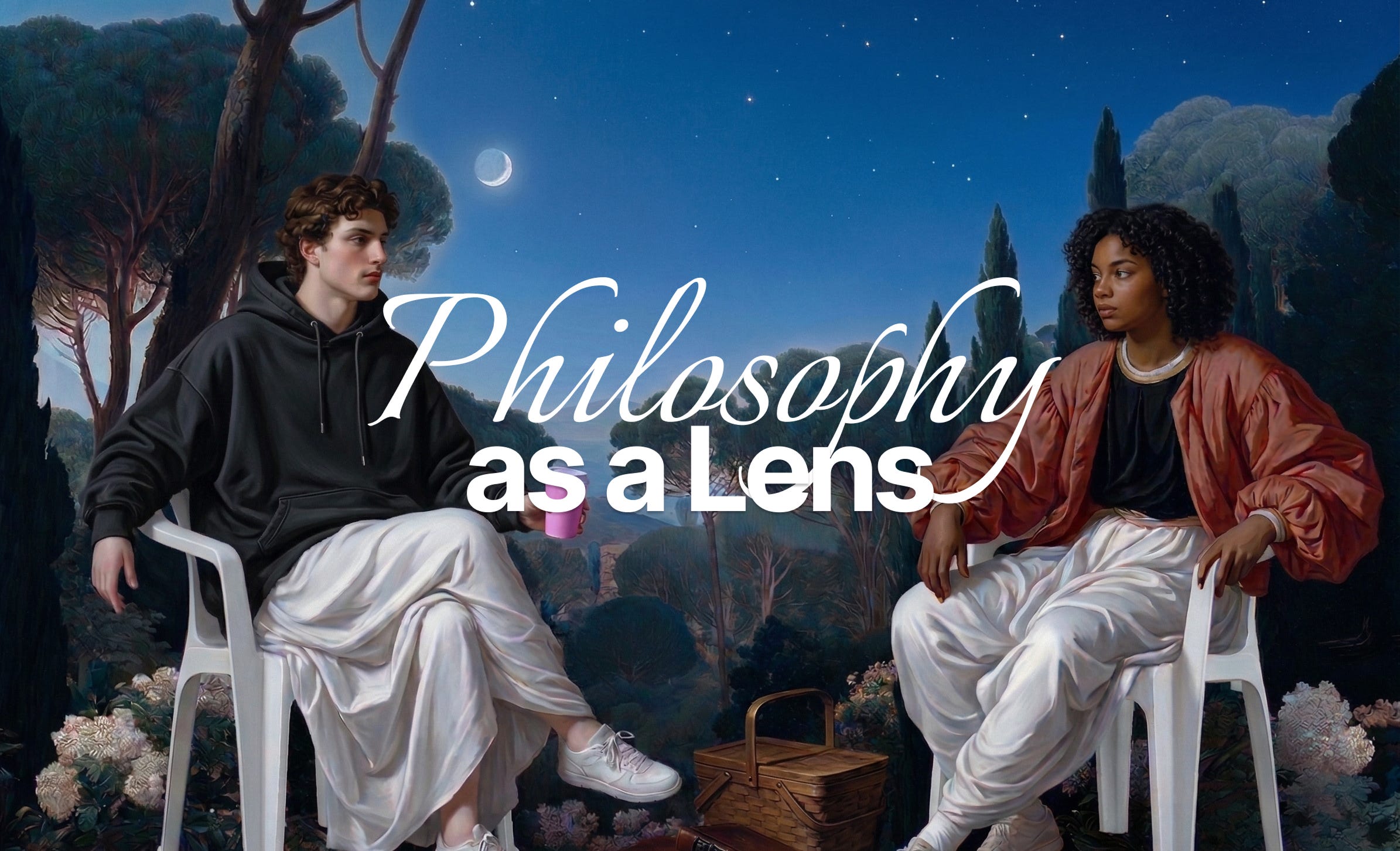
You know those late-night conversations. Outside, plastic chairs, something to drink. The kind where you end up talking about how small you are in the universe, or why some relationships break you in ways you can’t explain. No filters. Just what you actually think.
At some point someone pulls out their phone and you start naming the stars. Looking up the constellations. Arguing about which one is Orion.
You won’t remember the names by morning. You might not even remember who was there.
But the next time you’re outside at night, you’ll look up. You’ll search for the shapes. Something shifted, quietly, without you deciding it would.
That’s what philosophy became for me. Late-night conversations with people who looked at the same sky before I did. And took the time to name what they saw.
That’s probably why I’m writing.
Not to show off the constellations I found. Not to be the guy who read the books.
I want to point at the sky. Share the shapes I’ve learned to see. And figure out, by writing them down, which ones I still can’t name.
Some of these ideas I’ve carried for years. Others I’m still turning over. Writing is how I find out which is which.